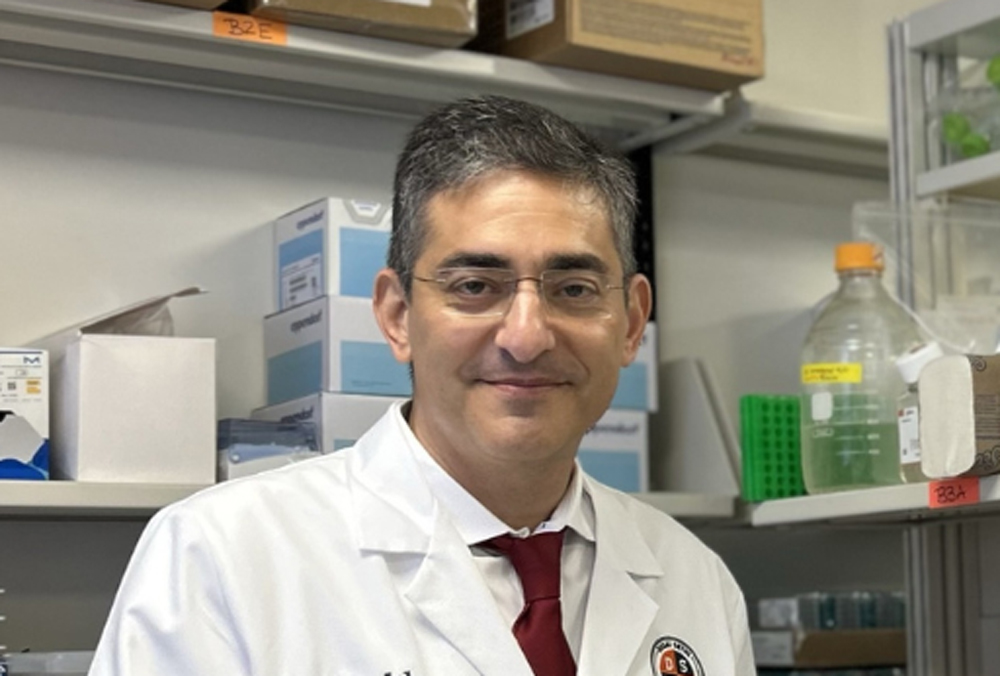
Jay Sosenko, M.D., describes his long, multidisciplinary career as being serendipitous. Indeed, his trajectory was often unpredictable — but also purposeful. A professor of medicine, he has earned a medical degree from Temple University and master’s degree in epidemiology from the Harvard T.H. Chan School of Public Health. He has held several academic and administrative positions at the Miller School of Medicine and has conducted pioneering research at the school’s Diabetes Research Institute (DRI). Yet, that pathway has involved unforeseen twists and turns.
After completing his residency in internal medicine at UCLA, Dr. Sosenko pursued a fellowship in adolescent medicine at Boston Children’s Hospital. “While there, I learned that investigators were developing a test for hemoglobin A1C that could revolutionize the care of patients with diabetes,” he said. “It has since become a crucial measure for long-term blood glucose management. I was fascinated by this test, and as a young investigator, I welcomed an opportunity to join that group in a clinical research study.”
Thus began Dr. Sosenko’s sharp focus on Type 1 diabetes. During his time at Boston Children’s Hospital, he obtained a master’s degree in epidemiology, after which he moved to the University of Miami and the DRI, where he saw adolescent patients with diabetes and performed research in the epidemiology of diabetic peripheral neuropathy.

“I believe this breakthrough could be a major step, ultimately leading to the prevention of Type 1 diabetes.”
Jay Sosenko, M.D.
From there, serendipity kicked in. Jay Skyler, M.D., a colleague at the DRI, had been selected as the chair of TrialNet, an international research network funded by the National Institute of Diabetes and Digestive and Kidney Diseases; it follows individuals at risk for Type 1 diabetes and conducts clinical trials aimed at delaying progression of the disease. One day, which Dr. Sosenko won’t forget, Dr. Skyler invited him to be an associate chair of epidemiology and ethics for TrialNet. This offered Dr. Sosenko an opportunity that he had long desired, which was to analyze large databases of individuals at risk for Type 1 diabetes.
“It changed my life,” Dr. Sosenko said of joining TrialNet, which in turn has altered the course of diabetes research prior to diagnosis. Utilizing the network’s robust database and another large database from the Diabetes Prevention Trial-Type 1 (DPT-1), he began to analyze data with the goal of improving the performance of Type 1 diabetes prevention trials. An early accomplishment was the development of a risk score for Type 1 diabetes, known as the Diabetes Prevention Trial–Type 1 Risk Score. A more accurate prediction of the likelihood of being diagnosed with Type 1 diabetes, it is based on combining the measurement of glucose with the measurement of a derivative of insulin, C-peptide.
Dr. Sosenko subsequently used the approach of combining glucose and C-peptide as a basis for developing other measures, which have been used to improve our understanding of the natural history of Type 1 diabetes, and to develop new endpoints that have the potential to improve detecting the effects of experimental treatments. “Overall, these innovations could aid in finding effective treatments that would otherwise not have been found without them,” he said. “A medication has now been identified in TrialNet that delays the progression to Type 1 diabetes, making me cautiously optimistic about the future. I believe this breakthrough could be a major step, ultimately leading to the prevention of Type 1 diabetes.”