A Better Way to Treat Type 1 Diabetes

A Better Way to Treat Type 1 Diabetes
In 1922, after years of fundamental bench research, the first Type 1 diabetes patient received a radical new treatment: injected insulin. Up to that point, Type 1 diabetes, at that time called juvenile diabetes, had been a death sentence. Insulin gave patients a powerful tool to control blood sugar and extend their lives.
But insulin is not a cure. People living with Type 1 diabetes must constantly monitor their blood sugar, diet and physical activity, and periodically inject insulin to maintain their health. Even with today’s automated glucose monitoring and insulin delivery systems, it’s a tough road.
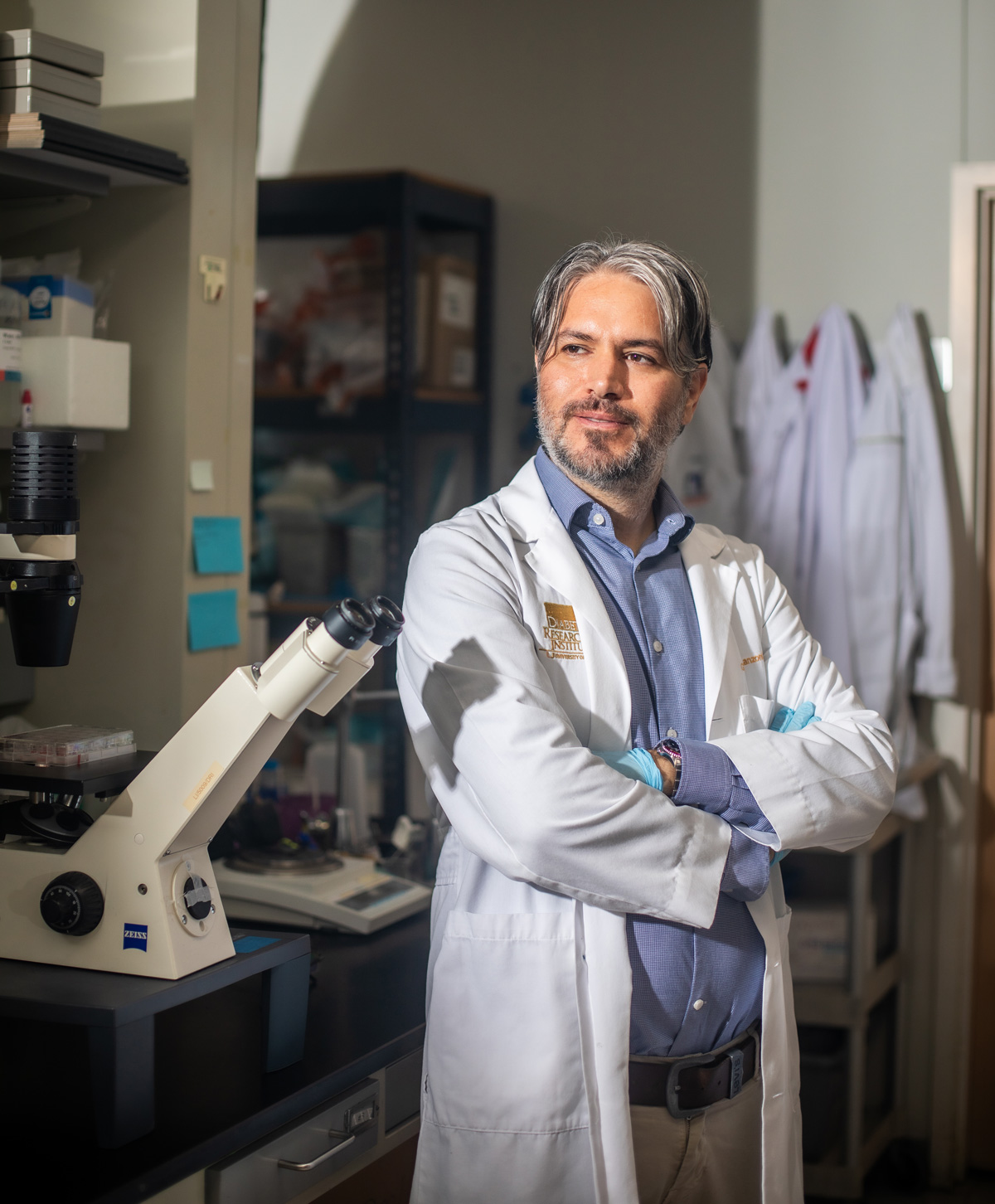
Giacomo Lanzoni, Ph.D., and colleagues at the Diabetes Research Institute at the Miller School of Medicine are working on a better solution: transplanting insulin-producing islet cells that will maintain healthy blood sugar 24/7. It’s a complicated mission, but the payoffs for patients would be enormous.
“Managing Type 1 diabetes is a tremendous burden on patients and their families,” said Dr. Lanzoni, research assistant professor of biochemistry and molecular biology. “We are developing a strategy that could replace injected insulin and work almost like a cure.”
“It’s a compelling example of how translational research should progress.”
Giacomo Lanzoni, Ph.D.
Keeping Islet Cells Safe
Insulin is a hormone that signals cells to take in and use blood sugar. Without it, cells cannot properly use this energy supply, and glucose levels rise to toxic concentrations in the blood. Type 1 is an autoimmune condition in which T cells mistakenly attack the pancreatic islet beta cells that produce insulin, gradually destroying the cells and the insulin they produce.
Dr. Lanzoni’s team is exploring a combination strategy involving pancreatic islet cell transplantation and supportive therapies to improve islet survival and function. However, one main challenge remains: how to protect the transplanted islet cells from the patient’s immune system.
“Transplant recipients take powerful drugs that suppress the immune system throughout the body,” Dr. Lanzoni said. “But when the immune system is not working properly, it puts the patient at risk for infection, tumors and other side effects. These drugs are also quite toxic and not ideal for long-term treatment.”
A key component of the combination strategy involves mesenchymal stem cells (MSCs) — multipotent cells that can promote tissue regeneration, revascularization and local immune modulation.
Derived from umbilical cord tissue, these MSCs — and the mediators they release — monitor and regulate the immune response near the transplant site. Rather than systemically suppressing immunity, they calm immune activity where protection is most needed: around the transplanted islets.
“We envision a combination of stem-cell-derived islets and an immunomodulatory strategy that acts specifically at the transplant site,” Dr. Lanzoni said. “We want to protect the transplanted insulin-producing cells but also avoid toxicity to the rest of the body.”
A Local Biotech Collaboration
Dr. Lanzoni is collaborating with Miami-based biotech company iTolerance to make the immunomodulation even more robust. The company developed an agent called iTOL-100 that can modulate the immune response around an islet transplant site.
Their approach leverages a protein called Fas ligand, which the body naturally uses to regulate immune responses. When co-transplanted with islet cells, the protein instructs attacking immune cells to self-destruct and promotes the growth of cells that keep the immune system in balance.
In a study presented at the 2024 American Diabetes Association meeting, Dr. Lanzoni demonstrated that transplanted, stem-cell-derived islet cells, delivered with iTOL-100, reversed Type 1 diabetes in animal models.
“It’s a compelling example of how translational research should progress,” Dr. Lanzoni said. “After years of study, we are now moving this technology toward the clinic. We hope that, in the near future, it will make life significantly easier and safer for those living with Type 1 diabetes.”
SHARE