Gwendolyn Sutton, a second-year M.D. candidate on the global health and surgery pathway at the University of Miami Miller School of Medicine, intends to be a globally minded physician who can adapt to unfamiliar environments. This past summer, she wanted to both participate in advanced, clinically relevant research and experience cultural immersion. So, she put it all together and sought an internship in Japan.
After a rigorous application process and acceptance, Sutton spent seven weeks at Japan’s National Institute for Materials Science (NIMS) through an internship with SPHinX Inc., a NIMS biotech startup founded in 2024, located adjacent to the NIMS headquarters. Working under principal investigator Mitsuhiro Ebara, Ph.D., the president and CEO of SPHinX and group leader of the Smart Polymers Group at NIMS, Sutton assisted with bench science on a temperature-responsive polymer to improve viral diagnostics. The project’s goal is to improve the sensitivity of rapid HIV antigen tests by using a temperature-responsive smart polymer to capture and enrich target viral biomarkers before detection. This approach could enable detection of lower concentrations of viral biomarkers than a conventional rapid test, shortening the period from initial infection to the time when positive results show up on a test.
SPHinX also has developed an assay for hepatitis C, which has undergone prospective multinational clinical evaluation. In fact, smart polymers could be applied to COVID-19 testing, too, and potentially adapted to other infectious-disease targets, according to Sutton. “As long as you have a target, you can adopt this for most diseases,” she said. In this approach, antibodies attached to the smart polymer capture the target biomarker in a patient sample. When the sample is warmed, the temperature-responsive polymer changes its solubility and concentrates the captured target, enhancing the signal of the rapid test.


Making Chemical Compounds
The process of making this smart polymer is labor intensive. First, scientists in the lab synthesize a monomer named HIPAAm, then copolymerize it with another monomer, NIPAAM, creating a temperature-responsive polymer. Next, they react the polymer with DBCO acid to introduce functional groups that could attach to the target, making the SAKIPAAm polymer. “The SAKIPAAm polymer had an X on it, and the X is looking for a Y in the patient’s serum,” Sutton explained. “When the X and the Y come together and warmth is applied, that is when you can use the temperature-responsive polymer to enrich the reaction.”
For the first few weeks of her internship, Sutton followed Omata, a SPHinX employee and member of the research team, observing experiments. They occurred in a wet lab, where different chemical compounds and polymer formulations were prepared and evaluated. While still working with Omata daily, Sutton eventually was able to do experiments on her own. Under supervision, she prepared solutions, ran tests, managed samples and recorded data. She also took guidance from the post-doc in the lab, Nabil. “Nabil and I would brainstorm how to approach the project, and he guided me throughout the internship,” said Sutton.
Since her internship’s end, Sutton’s colleagues at NIMS have kept her up to date on the project. Recently, in Miami, she met with stakeholders to discuss with them the potential gap and need for continuing research here. Depending on the identified need and opportunities for collaboration, the team may continue evaluating the technology with partners in settings where accessible diagnostics are especially important. This includes Kenya, where their hepatitis C assay is in the clinical trial phase. According to Sutton, many regulatory, ethical and logistical steps are involved before diagnostic technology can be introduced into patient care. The hepatitis C assay has been in development for several years, and it’s only now in clinical trials.
Setting up the machine used to evaporate solvents during the purification process to help ensure the final product is pure.
Adding nitrogen gas during the synthesis of the monomer and polymer. Nitrogen helps create the right conditions for the chemical reactions.
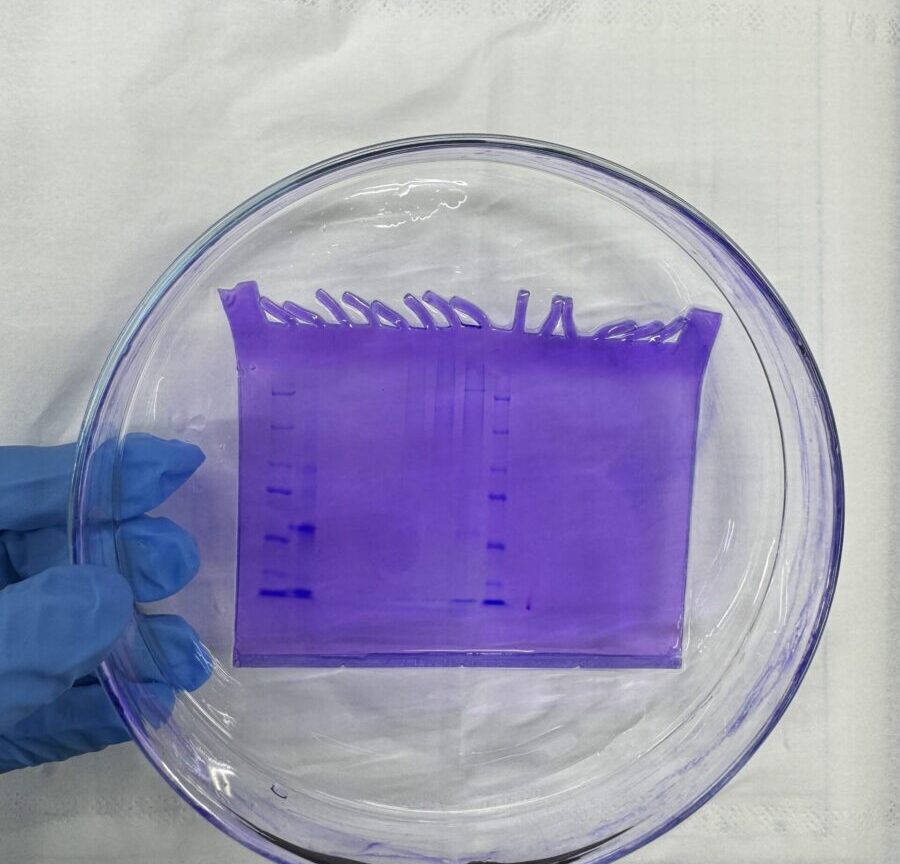
After staining the gel to make the proteins visible, Gwen removes the excess stain so the protein bands stand out more clearly. The shaker machine automatically moves the gel through the solution and every few minutes, Gwen replaces the solution to keep the destaining process effective.
Incorporating the Global Aspect
Sutton hasn’t yet decided which specialty she’ll pursue, but one thing’s for sure: “In the future,” she said, “I want to incorporate the global aspect.” The Miller School’s global pathway and her summer internship, she believes, will give good guidance as she prepares for a global health–related capstone project. “Doing research abroad in a program that is internationally recognized for their work in smart-polymer technologies allowed me to contribute to research techniques best known and employed at NIMS/SPHinX,” she said. She also valued the cultural-immersion aspect. “Being fully immersed in Japan allowed me to combine advanced clinical research with meaningful cross-cultural communication,” she said.
In addition to the research, Sutton made the most of her time there. She tried to never go straight home after work, opting instead to visit new restaurants and rank them online. She went on a weekend hiking trip to Nikko, a city in a mountainous region of Japan. She also squeezed in some volleyball on the NIMS campus, took in a baseball game and, of course, spent an evening singing karaoke with her coworkers.